
Precision Laser Cleaning Equipment
Products Details
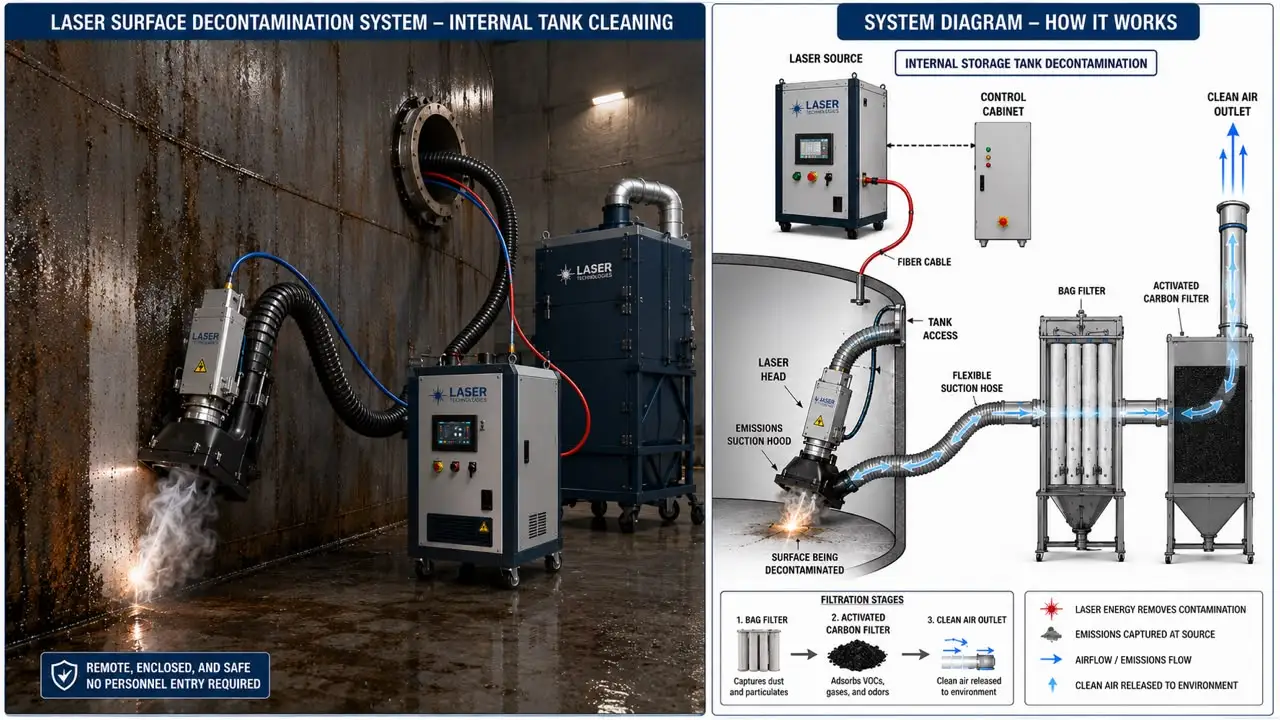
Precision Laser Cleaning Equipment are designed for selective cleaning and treatment of industrial surfaces and technical components using controlled laser energy. They are especially suitable where abrasive or chemical methods may be too aggressive, generate excessive secondary waste, or increase operator exposure. The system combines precision laser cleaning, source capture, and emission control in one controlled process.
The main advantage of this system is control. The laser can remove the unwanted layer while helping preserve the underlying substrate and nearby structures. This makes it suitable for industrial equipment, technical parts, metallic surfaces, coated surfaces, and sensitive process areas where accurate treatment is important.
Another key benefit is immediate capture of fumes and particles at the source. The extracted flow is treated through an emission-control line that can include bag filtration, activated carbon, and other optional depollution stages. This makes advanced Precision Industrial Cleaning Systems suitable for cleaner and safer industrial cleaning in demanding environments.
Product Drawing
| Designation | Characteristics |
| Reference | Precision Industrial Cleaning Systems |
| Application | Industrial equipment, technical parts, metallic surfaces, toxic coatings, hazardous deposits, sensitive process areas |
| Laser Power | 500 W – 12 kW configurable |
| Working Type | Robotized, teleoperated, or remotely supervised precision laser cleaning system |
| Treatment Principle | Selective laser cleaning with source aspiration and emission control |
| Laser Functions | Precision cleaning, stripping, residue removal, decontamination, selective surface treatment |
| Primary Treatment Head | Laser module, source aspiration inlet, optional gas nozzle, optional reagent injector, sensors |
| Emission Treatment Stage 1 | Source aspiration / local vacuum capture |
| Emission Treatment Stage 2 | Bag filter |
| Emission Treatment Stage 3 | Activated carbon filtration |
| Optional Depollution Modules | HEPA filter, gas scrubber, condenser, pre-separator, additional air-treatment components |
| Control System | Centralized command unit with thermal, visual, and atmospheric monitoring |
| Monitoring Equipment | Camera, thermal sensor, gas analyzer, intelligent sensors |
| Operation Mode | Remote, teleoperated, semi-autonomous, or robot-assisted |
| Installation Type | Mobile platform, articulated arm, carrier-mounted unit, or fixed station |
| Main Advantages | Precise treatment, reduced secondary waste, lower operator exposure, integrated emission control |
| Industrial Sectors | Industrial cleaning, maintenance, hazardous-material treatment, controlled environments |
How do Precision Industrial Cleaning Systems work?
Precision Industrial Cleaning Systems work by directing controlled laser energy onto the unwanted surface layer so that it can be removed selectively without excessive impact on the surrounding area. At the same time, the treatment head captures fumes, particles, and vapors directly at the source to reduce dispersion during operation.
After capture, the extracted flow passes through an emission-treatment line that can include bag filtration, activated carbon, and other optional depollution modules. The result is a controlled cleaning process that combines precision treatment with safer containment and cleaner industrial operation.
Application and Case
Precision Industrial Cleaning Systems are suitable for:
- Precision cleaning of industrial equipment
- Toxic coating stripping
- Hazardous deposit removal
- Technical surface preparation
- Sensitive component cleaning
- Controlled decontamination of process areas
- Metallic surface treatment
- Industrial maintenance and cleaning projects
Precision Laser Cleaning Equipment are especially suitable for operators who need a precise, remotely controlled, and low-dispersion solution for industrial cleaning and surface treatment. They are a strong choice for projects that require selective cleaning, integrated emission control, and improved operator safety compared with conventional abrasive or chemical methods.