
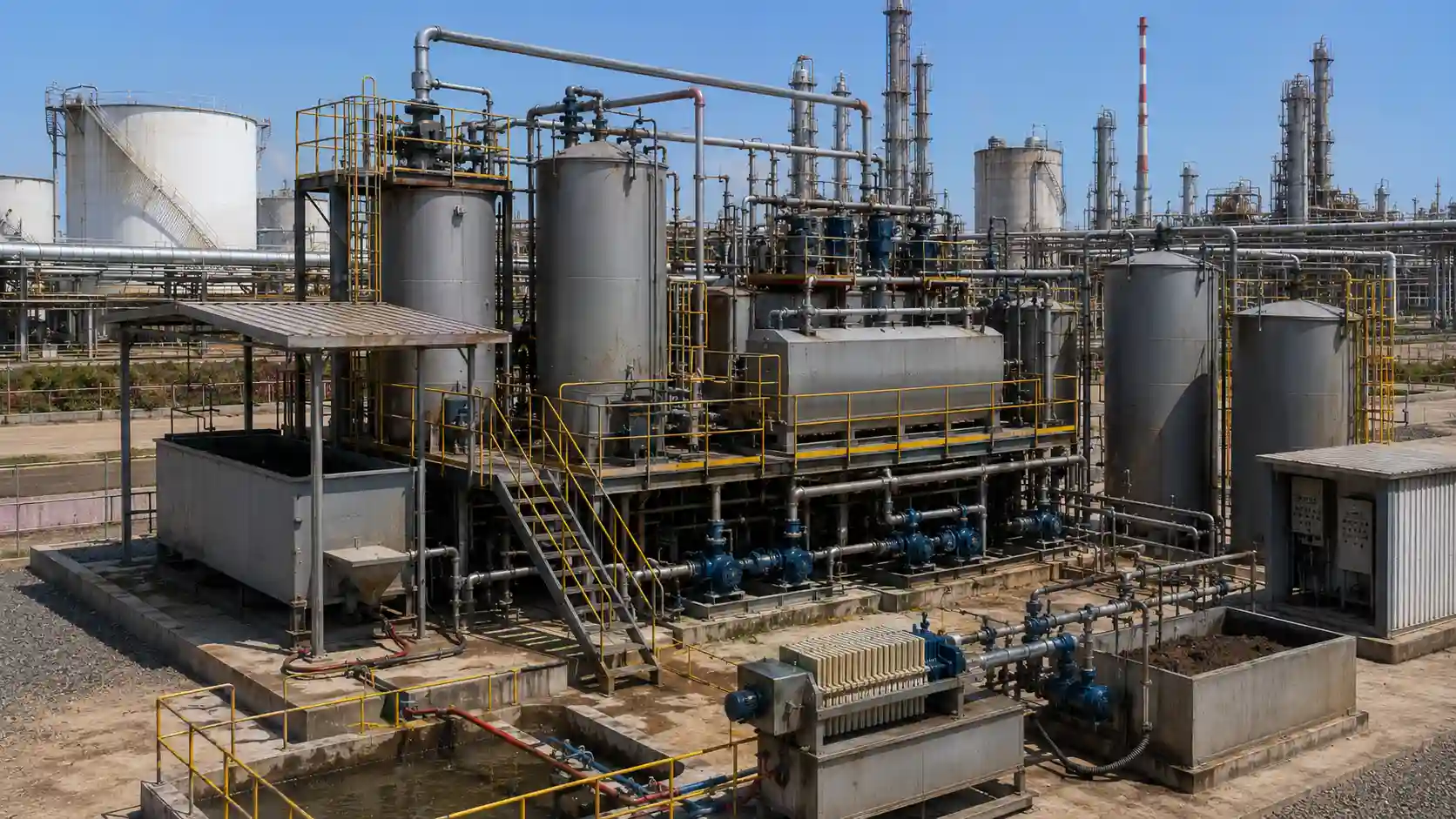
Oil Refinery Sludge Treatment System
Products Details
Oil Refinery Sludge Treatment systems are designed for the processing of sludge generated during refinery operations, tank cleaning, wastewater treatment, and hydrocarbon storage. These sludge streams often contain a mixture of oil, water, rust, sand, sediments, emulsified hydrocarbons, and fine solids, making them difficult to handle through simple storage or direct disposal. The purpose of the treatment system is to reduce sludge volume, improve handling, and process the waste into more manageable fractions under controlled industrial conditions.
A standard refinery sludge treatment system works through a combination of heating, conditioning, separation, and solids handling. The sludge is first received into the treatment line, where it is heated and mixed to reduce viscosity and weaken the bond between oil, water, and solids. This improves flow behavior and prepares the material for the next treatment stages.
Once conditioned, the sludge passes through separation stages where the main fractions are divided. The oil-rich fraction can be transferred for further treatment or storage, the water-rich fraction can be routed to wastewater handling, and the solid residue can be discharged for dewatering, stabilization, or disposal. This makes an integrated Oil Refinery Sludge Treatment process useful not only for waste reduction, but also for improved refinery housekeeping and more practical downstream waste management, including specialized refinery sludge treatment applications.
A standard installation may include sludge receiving tanks, feed pumps, heating and conditioning tanks, oil-water separation modules, settling or decantation sections, filtration equipment, sludge discharge, vapor control, and centralized automation. With capacities typically ranging from 1 T/h to 20 T/h, these systems are suitable for both medium and large refinery sludge-management projects where stable throughput and controlled processing are important.
Because refinery sludge composition can vary depending on the process unit, storage conditions, and cleaning method, systems for Oil Refinery Sludge Treatment are usually designed to be flexible and adaptable. They provide a practical industrial solution for operators who need to reduce sludge accumulation, improve waste organization, and manage refinery residues in a more controlled and efficient way.
Product Drawing
| Designation | Characteristics |
| Reference | Refinery Sludge Treatment |
| Application | Refinery sludge, tank-bottom sludge, API separator sludge, oily sediments, hydrocarbon-contaminated solids |
| Capacity | 1 T/h – 20 T/h typical industrial range |
| Working Type | Integrated refinery sludge conditioning and separation system |
| Treatment Principle | Heating, conditioning, separation, dewatering, and handling of oil, water, and solids |
| Typical Oil Content in Feed | 10–50% |
| Typical Water Content in Feed | 20–70% |
| Typical Solids Content in Feed | 10–60% |
| Feed Form | Semi-solid sludge, viscous refinery residues, oily sediments, contaminated solids |
| Main Process Stages | Sludge reception, heating, conditioning, separation, water handling, solids discharge |
| Typical Volume Reduction | 30–80% depending on sludge composition |
| Operating Mode | Batch, semi-continuous, or continuous depending on plant design |
| Oil Separation | Yes |
| Water Separation | Yes |
| Solids Handling | Yes |
| Heating Method | Indirect heating or controlled thermal conditioning |
| Control System | Centralized PLC or industrial control cabinet |
| Installation Type | Fixed industrial plant or modular skid-mounted system |
| Main Advantages | Reduced sludge volume, improved waste handling, adaptable refinery treatment design |
| Industrial Sectors | Refineries, petrochemicals, storage terminals, tank farms, industrial cleaning operations |
How Does Oil Refinery Sludge Treatment System Work?
Oil Refinery Sludge Treatment System works by first receiving the sludge into a treatment section where the material is heated and conditioned to improve separation. This step reduces viscosity, weakens the emulsion between hydrocarbons and water, and makes the sludge easier to process.
After conditioning, the sludge moves through separation stages where the oil-rich phase, water-rich phase, and solid residue are divided and handled individually. Depending on the plant design, the system may include settling, gravity separation, filtration, controlled transfer, and dewatering steps.
The final result is a controlled industrial process that reduces sludge volume, improves waste handling, and converts complex refinery sludge into output streams that are easier to store, transfer, treat further, or dispose of.
Application and Case
Refinery Sludge Treatment is suitable for:
- Tank-bottom sludge treatment
- API separator sludge treatment
- Refinery wastewater sludge processing
- Hydrocarbon-contaminated sediment treatment
- Petrochemical sludge treatment
- Storage tank cleaning residues
- Refinery maintenance waste treatment
- Industrial sludge management operations
Oil Refinery Sludge Treatment is especially suitable for operators who need a reliable industrial solution for processing refinery-generated sludge under controlled conditions. Implementing a dedicated Thermal Desorption System alongside conditioning systems makes it a strong choice for projects that require sludge volume reduction, improved handling, stable throughput, and more efficient management of oily refinery residues.