
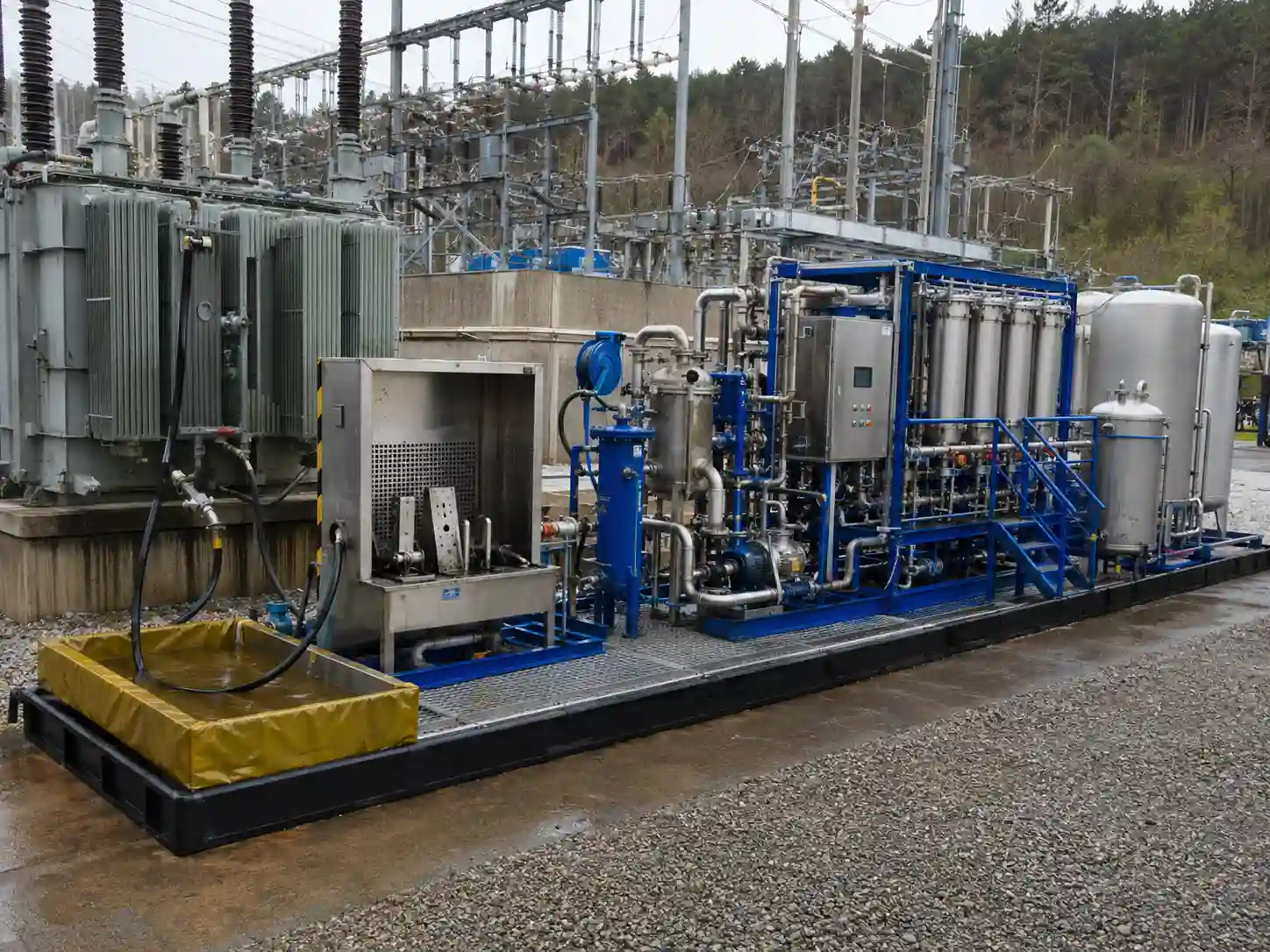
On-site Decontamination Units
Products Details
On-site Decontamination Units are designed for treatment operations carried out directly at maintenance, decontamination, or hazardous-waste handling sites where PCB-contaminated oils and dielectric fluids are collected from transformers and electrical equipment. They are especially suitable for projects that require a controlled chemical treatment process before transfer, storage, disposal, or incineration.
The system works through co-catalyst-assisted dechlorination at 80°C to 100°C using an integrated heated reactor, controlled agitation, and optimized reaction chambers. The treatment process is based on Pd/C and activated kaolin, which are used to improve dechlorination efficiency and reduce PCB toxicity under monitored operating conditions.
After reaction, the treated stream passes through filtration and separation, followed by final evaluation before storage or final handling. Integrating specialized On-site Transformer Oil Dechlorination Systems also includes thermal protection, pressure control, emergency stop, and controlled handling of spent catalyst and contaminated residues, making it suitable for safer operation in site-based treatment environments.
Product Drawing
| Designation | Characteristics |
| Reference | On-site Decontamination Units |
| Application | Site-based treatment of PCB-contaminated oils, dielectric fluids, and chlorinated residues |
| Working Type | On-site chemical PCB dechlorination system |
| Operating Temperature | 80°C – 100°C |
| Treatment Principle | Co-catalyst-assisted chemical dechlorination |
| Main Treatment Media | Pd/C, activated kaolin |
| Reactor Design | Integrated heating with controlled agitation |
| Core Process | Inspection, pretreatment, heating, solvent introduction, co-catalyst injection, reaction, filtration, separation, final validation |
| Filtration System | Advanced filtration for treated output and solid residues |
| Control System | Digital control panel with monitored operating parameters |
| Safety Features | Thermal protection, pressure control valves, emergency stop |
| Residue Handling | Controlled handling of spent kaolin, catalysts, and contaminated solids |
| Main Advantages | Reduced PCB toxicity, site-based treatment flexibility, safer downstream handling |
| Industrial Sectors | Electrical maintenance, hazardous oil treatment, PCB waste management, field decontamination |
How do On-site Decontamination Units work?
On-site Decontamination Units begin with inspection and pretreatment of the contaminated oil or liquid collected at the site. The reactor is then brought to the required range of 80°C to 100°C, and the process starts with solvent introduction, precise co-catalyst dosing, and controlled mixing inside the reactor.
During the reaction stage, the unit promotes dechlorination using Pd/C and activated kaolin under monitored conditions. Once treatment is complete, the output moves to filtration and separation, then to final evaluation before storage, transfer, disposal, or incineration.
Application and Case
On-site Decontamination Units are suitable for:
- Site-based transformer oil treatment
- Electrical equipment maintenance projects
- Hazardous oil pretreatment before transfer
- CB-related cleanup operations
- Field decontamination programs
- Controlled chemical treatment of contaminated liquids
On-site Decontamination Units are especially suitable for operators who need a controlled on-site PCB treatment process with moderate operating temperature, structured reaction control, and safer handling of contaminated oils and residues before final disposal. Integrating a dedicated PCB Dechlorination System is a strong choice for projects requiring high-efficiency decontamination and hazardous residue containment.