
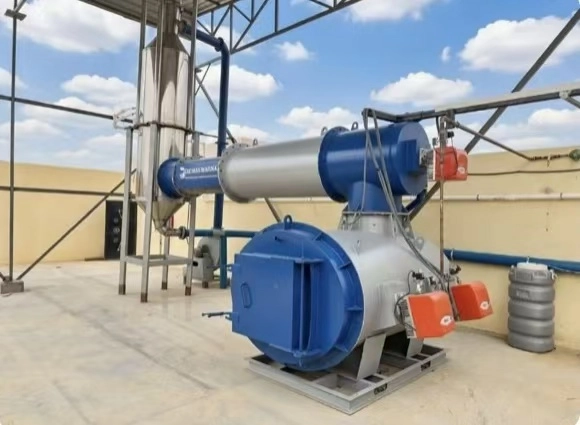
Organic Waste Incinerator
Products Details
The Organic Waste Incinerator is designed for the safe thermal destruction of biodegradable and high-moisture organic waste generated by food-processing plants, slaughterhouses, farms, agricultural operations, municipalities, hotels, restaurants, and industrial facilities. The rotary combustion chamber
The system consists of a primary rotary combustion chamber followed by a high-temperature secondary combustion chamber where unburned gases are completely oxidized before entering the emission-treatment system. The rotary design improves combustion efficiency, reduces ash accumulation, and minimizes manual intervention compared with conventional static Waste Incinerator units.
Depending on project requirements, the incinerator can be integrated with waste feeding systems, ash discharge conveyors, heat recovery equipment, and complete flue-gas cleaning systems including cyclones, scrubbers, bag filters, and activated-carbon units to comply with environmental regulations.
Designed for continuous industrial operation, the Organic Waste Incinerator provides reliable volume reduction, odor elimination, pathogen destruction, and environmentally controlled waste disposal while significantly reducing the amount of waste sent to landfill.
Product Drawing
| Designation | Characteristics |
| Reference | Organic Waste Incinerator |
| Application | Organic waste, food waste, agricultural waste, slaughterhouse waste, green waste, biodegradable industrial waste |
| Capacity | 100 kg/h – 2,000 kg/h |
| Working Type | Rotary direct-combustion incinerator |
| Primary Chamber Temperature | 750–900°C |
| Secondary Chamber Temperature | 950–1,150°C |
| Residence Time | ≥2 seconds |
| Combustion Chamber | Rotary cylindrical kiln |
| Fuel Type | Diesel, Natural Gas, LPG, Heavy Fuel Oil |
| Feeding System | Manual or automatic |
| Ash Removal | Automatic or manual |
| Control System | PLC with touchscreen HMI |
| Emission Treatment | Optional cyclone, scrubber, bag filter, activated carbon |
| Installation Type | Fixed industrial plant |
| Main Advantages | Continuous combustion, uniform heat distribution, high destruction efficiency, reduced odor, reduced waste volume |
| Industrial Sectors | Food processing, agriculture, slaughterhouses, municipalities, hotels, restaurants, industrial organic Waste Management Equipment |
How does an Organic Waste Incinerator work?
Organic waste is loaded into the rotary combustion chamber, where continuous rotation mixes the material to promote uniform burning. The primary chamber evaporates moisture and initiates combustion, while the rotating action exposes fresh waste surfaces to heat and oxygen.
The combustion gases then pass into the secondary combustion chamber, operating at temperatures up to 1,150°C with a minimum 2-second residence time, ensuring complete oxidation of volatile compounds and odors.
Finally, the flue gases pass through the emission-control system before discharge through the stack, while the remaining inert ash is collected for disposal.
Applications
The Organic Waste Incinerator is engineered to handle diverse high-moisture and biodegradable waste streams across various sectors:
-
Food Waste Disposal: Efficiently eliminates commercial food scraps, post-consumer leftovers, and bulk kitchen waste from large facilities, ensuring fast volume reduction and odor-free processing.
-
Agricultural Waste Treatment: Ideal for processing crop residues, spoiled produce, harvest by-products, and farm organic slurry to prevent soil contamination and disease spread.
-
Slaughterhouse Waste Destruction: Safely disposes of abattoir offal, soft tissues, blood residue, and processing trimmings under high temperatures to ensure strict biological safety.
-
Animal By-Products: Processes non-rendered animal parts, hatchery waste, and processing by-products while eliminating pathogens and harmful biological agents.
-
Fruit and Vegetable Processing Waste: Effectively burns high-moisture organic residues, organic peels, hulls, and discarded crops from large-scale industrial food processing plants.
-
Market and Supermarket Organic Waste: Destroys expired produce, unsellable grocery items, damaged organic goods, and wholesale market leftovers to minimize landfill dependency.
-
Green Waste Treatment: Handles yard trimmings, park waste, landscaping debris, and plant material, turning bulky biomass into minimal inert ash.
-
Organic Industrial Waste: Processes biodegradable manufacturing residues, sludge from organic processing units, and non-hazardous bio-industrial waste streams.
-
Municipal Biodegradable Waste: Serves as a key component for municipal waste management, handling segregated household organic waste and wet organic fractions.
-
Hospitality and Catering Waste: Manages large-scale organic waste generated by hotels, resorts, institutional cafeterias, and commercial dining venues efficiently on-site.