
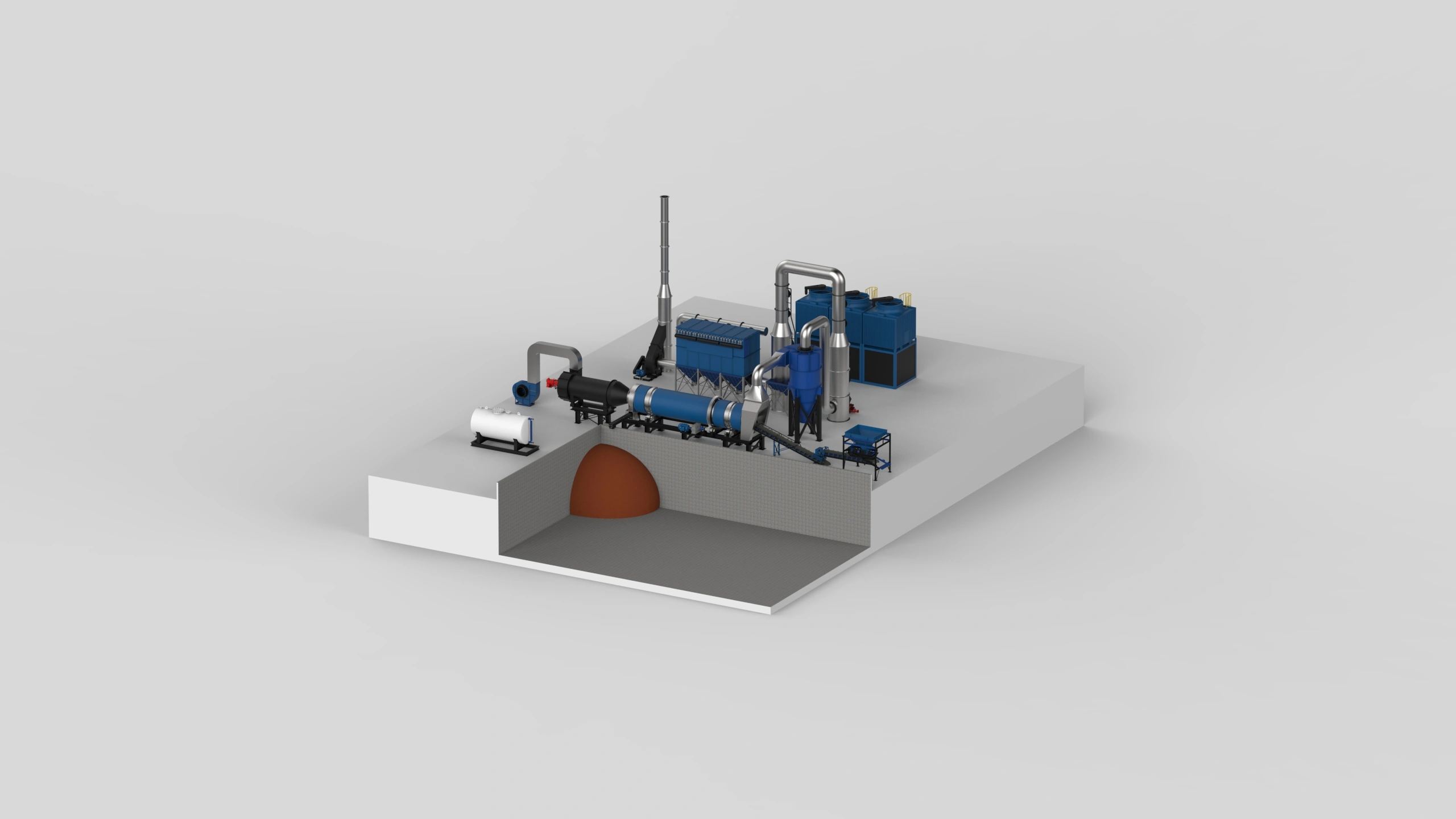
Tank Bottom Sludge Treatment System
Products Details
Tank bottom sludge treatment with Oil Sludge Thermal Treatment Systems is designed for the treatment of oily sludge generated by refineries, crude-oil storage tanks, petrochemical plants, and industrial cleaning operations. These waste streams usually contain a complex mixture of hydrocarbons, water, sand, rust, and fine solids, which makes them difficult to handle through simple storage or direct disposal. The purpose of the system is to reduce sludge volume, improve handling, and thermally treat hydrocarbon-bearing waste under controlled industrial conditions.
A standard direct thermal treatment system works by exposing the sludge directly to high temperature inside the treatment section. Under these conditions, moisture and organic contaminants are vaporized, while the remaining solid fraction continues through the process. In the direct-treatment flow shown in your technical sheet, the treated vapors then pass through a cyclone, followed by a thermal oxidizer, a wet scrubber, a bag filter, and finally the stack for controlled atmospheric discharge.
The main thermal treatment stage typically operates between 400°C and 800°C, while the thermal oxidizer operates at 850°C to 1100°C to continue burning the vapors and reduce harmful emissions. This process makes the system suitable for sludge streams that require strong thermal treatment and integrated gas cleaning rather than simple storage or mechanical handling.
A standard installation may include sludge feeding, hopper and conveyor system, direct-heating treatment unit, cyclone separator, thermal oxidizer, wet scrubber, bag filter, induced-draft fan, stack, and centralized automation. With a treatment capacity of 5 T/h to 20 T/h, these oil sludge treatment system options are suitable for medium and large sludge-treatment projects where stable throughput, strong contaminant destruction, and controlled emission treatment are important.
Product Drawing
| Designation | Characteristics |
| Reference | Tank Bottom Sludge Treatment Systems |
| Application | Oily sludge, tank-bottom sludge, refinery sludge, hydrocarbon-contaminated semi-solid waste |
| Capacity | 5 T/h – 20 T/h |
| Working Type | Direct thermal treatment system |
| Treatment Principle | Direct heating, vaporization of organic contaminants, thermal oxidation, and emission treatment |
| Typical Oil Content in Feed | 10–60% |
| Typical Water Content in Feed | 20–80% |
| Typical Solids Content in Feed | 5–40% |
| Feed Form | Semi-solid sludge, viscous residues, oily sediments, contaminated solids |
| Typical Thermal Treatment Temperature | 400°C – 800°C |
| Thermal Oxidizer Temperature | 850°C – 1100°C |
| Main Process Stages | Sludge reception, feeding, direct thermal treatment, cyclone separation, thermal oxidation, wet scrubbing, bag filtration, stack discharge |
| Typical Volume Reduction | 30–80% depending on sludge composition |
| Operating Mode | Batch, semi-continuous, or continuous depending on plant design |
| Particle Separation | Cyclone |
| Gas Treatment Stage 1 | Thermal oxidizer |
| Gas Treatment Stage 2 | Wet scrubber |
| Gas Treatment Stage 3 | Bag filter |
| Control System | Centralized PLC or industrial control cabinet |
| Installation Type | Fixed plant or modular skid-mounted system |
| Main Advantages | Strong thermal treatment, reduced sludge volume, integrated emission control, improved waste handling |
| Industrial Sectors | Refineries, petrochemicals, tank farms, oil terminals, industrial cleaning operations |
How Does Tank Bottom Sludge Treatment Work in Oil Sludge Thermal Treatment Systems?
Tank bottom sludge treatment works by feeding the heavy oil sludge into a direct-heating treatment section, where the waste is exposed to elevated temperature under controlled operating conditions. This direct thermal exposure vaporizes moisture and hydrocarbon contaminants while reducing the mass and volume of the original sludge.
The vapors generated during the tank bottom sludge treatment process are then transferred to a downstream gas-treatment line. According to the process flow shown in the technical sheet, this line includes a cyclone for particle separation, a thermal oxidizer for continued high-temperature burning of vapors, a wet scrubber for gas cleaning, and a bag filter for final particulate capture before atmospheric discharge through the stack.
The result is a controlled industrial process that achieves high-performance tank bottom sludge treatment, reduces sludge volume, thermally treats hydrocarbon-bearing waste, and manages the resulting emissions through a complete pollution-control sequence.
Application and Case
Oil Sludge Treatment Systems for tank bottom sludge treatment are suitable for:
-
Refinery sludge treatment
-
Tank-bottom sludge processing
-
Petrochemical sludge treatment
-
Oil terminal cleaning waste
-
Tank-cleaning residue treatment
-
Hydrocarbon-contaminated semi-solid waste
-
Industrial sludge treatment projects
-
Petroleum waste management operations
Oil Sludge Treatment Systems are especially suitable for operators who need a reliable direct thermal treatment solution for oily sludge in medium and large projects. With capacities from 5 T/h to 20 T/h, implementing a specialized Thermal Desorption System ensures that tank bottom sludge treatment projects achieve strong thermal treatment, reduced sludge volume, and integrated emission management under controlled industrial conditions.