Rotary Industrial Waste Incinerator – BRS Series
Products Details
Rotary Industrial Waste Incinerator – BRS Series is designed for industrial users who want a reliable rotary incineration system combined with a dry fume-treatment process. This series is particularly suitable for sites where water consumption must be minimized, where liquid effluent handling is undesirable, or where operators prefer a simpler dry-treatment configuration for long-term plant operation. Industrial waste often includes solids, sludge-like materials, production rejects, chemical residues, petrochemical by-products, and mixed combustible fractions. The BRS Series is built to manage these demanding waste streams with stable combustion, durable construction, and controlled atmospheric emissions.
The BRS Series is based on a double-chamber combustion design. The rotary primary chamber improves movement of the waste mass inside the furnace, helping to expose more surface area to heat and reduce untreated pockets inside the load. This improves thermal contact and makes the system more effective for industrial waste streams that are not homogeneous. The secondary chamber operates as a post-combustion zone with a 2-second residence time, providing additional oxidation of gases and helping deliver cleaner fumes to the emission-treatment system. This configuration supports high destruction performance and dependable process stability in industrial applications.
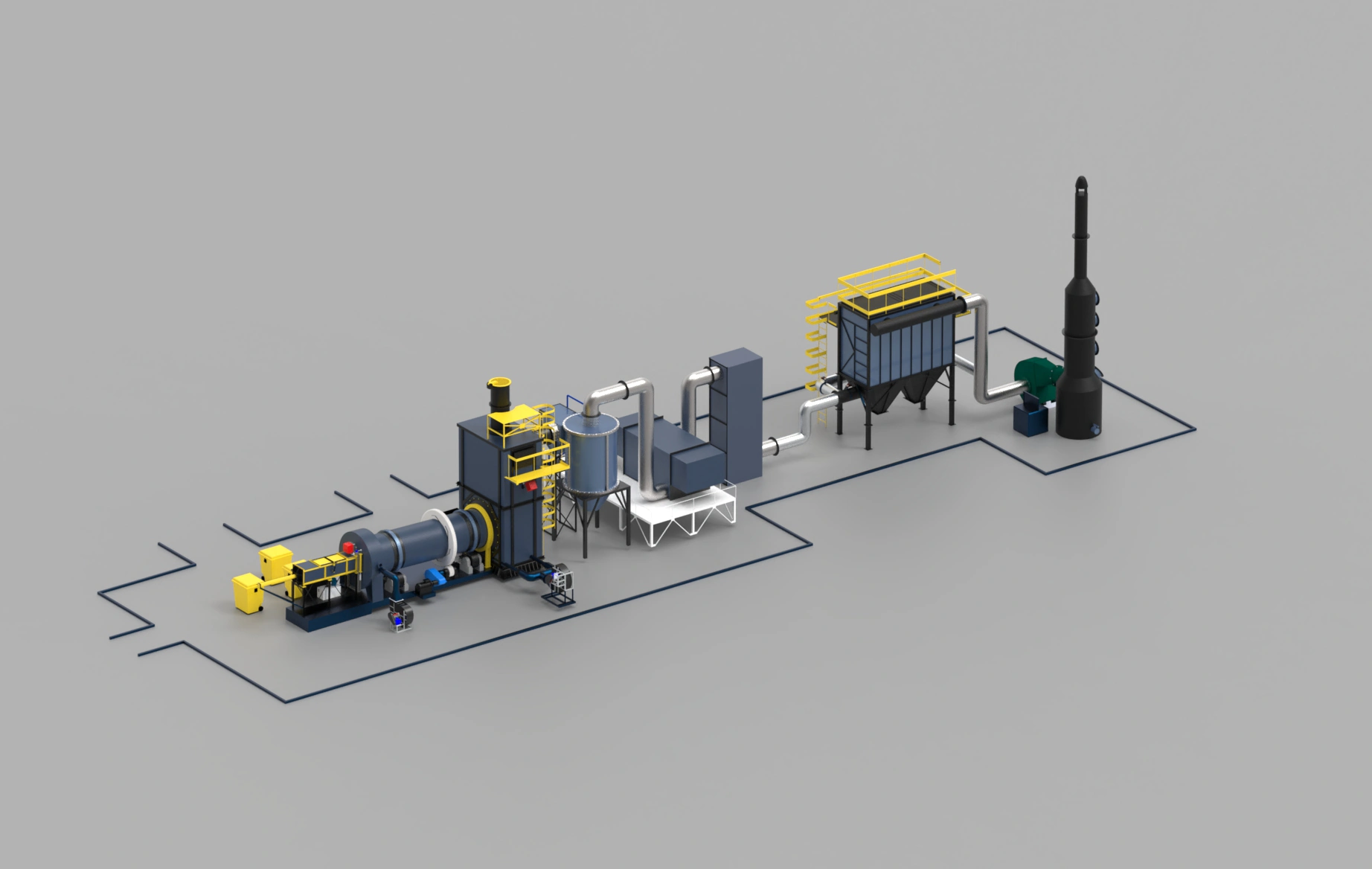
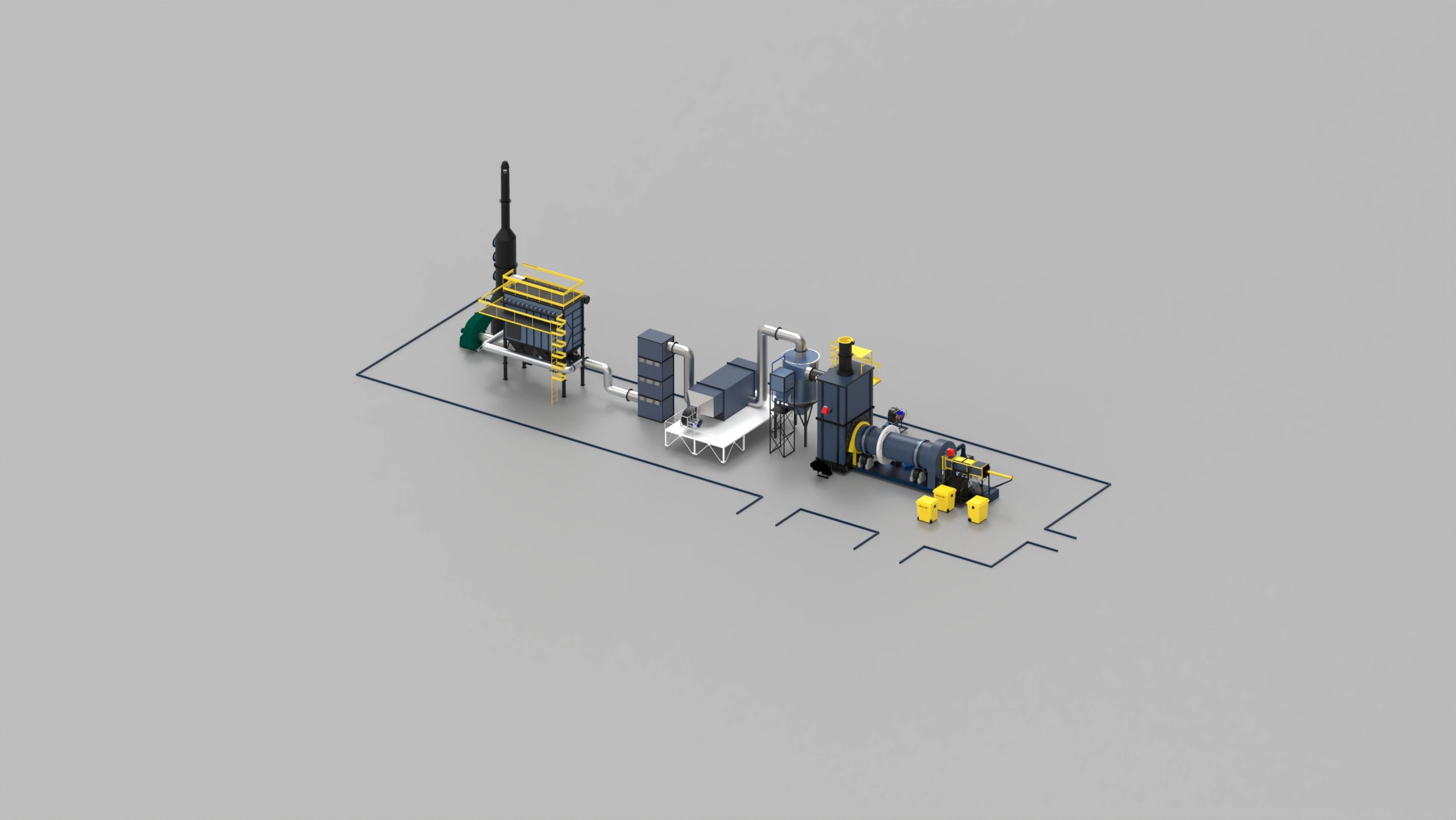
The key difference of the BRS Series lies in its dry emission treatment station. This dry line is built around a set of physico-chemical devices designed to separate particles, cool the gas stream, neutralize acidic compounds, and capture persistent pollutants before final discharge. Typical stages include reagent injection, a cyclone for mechanical particle separation, an air/fume heat exchanger, a honeycomb activated carbon filter, and a bag filter for continuous retention of fine particles. The use of dry treatment gives the BRS Series a practical advantage in installations where operators want effective gas cleaning without the complexity of water-based washing circuits.
One of the strongest selling points of the BRS Series is that the dry process can operate without producing liquid effluent from the gas-treatment line. Reagents such as lime and sodium bicarbonate can be injected to react with acid gases including sulfur compounds and hydrofluoric components, while activated carbon helps capture dioxins, furans, odors, solvents, VOCs, and heavy metals. The bag filter then acts as a final high-efficiency barrier for fine dust and reagent residues. This makes the BRS Series especially attractive for industrial projects seeking a more compact and utility-efficient emission-control solution while still maintaining strong environmental performance.
From an operational point of view, the BRS Series can also include an automatic loading system and a de-ashing mechanism, helping reduce manual intervention and improve plant ergonomics. This is important in industrial applications where waste handling must remain safe, repeatable, and productive over long operating periods. The result is a scalable rotary incineration platform that combines strong combustion performance with the practical advantages of dry emission treatment.
Product Drawing
| Designation | Characteristics |
| Reference | BRS Series |
| Type | Rotary industrial waste incinerator |
| Application | Industrial waste treatment |
| Available Models | BRS-150, BRS-200, BRS-250, BRS-500, BRS-700, BRS-1000 |
| Destruction Capacity | 150 / 200 / 250 / 500 / 700 / 1000 kg/h |
| Combustion Chambers | Rotary primary chamber + secondary post-combustion chamber |
| Primary Chamber Temperature | 800°C |
| Secondary Chamber Temperature | 1100°C |
| Gas Residence Time | 2 seconds |
| Waste Forms | Solid, sludge, semi-solid, mixed industrial residues |
| PCI Moyen de Déchets | Approx. 2,500–6,000+ kcal/kg |
| Emission Treatment Type | Dry emission treatment station |
| Main Treatment Components | Reagent injection, cyclone, air/fume heat exchanger, activated carbon filter, bag filter |
| Main Treatment Functions | Particle separation, gas cooling, acid gas neutralization, VOC and dioxin capture, fine dust filtration |
| Reagent Options | Lime, sodium bicarbonate, activated carbon, selected dry additives |
| Effluent Management | No liquid effluent from the dry gas-treatment line |
| Loading System | Manual or automatic loading |
| Residue Handling | Assisted de-ashing / decentering mechanism |
| Main Advantages | Dry treatment, reduced water dependency, compact gas-cleaning line, strong industrial reliability |
| Fuel | Natural Gas / Diesel |
| Industrial Positioning | Medium to high-capacity dry-treatment industrial incineration projects |
How does the Rotary Industrial Waste Incinerator – BR-S Series work?
The BRS Series begins with combustion inside the rotary primary chamber, where industrial waste is exposed to controlled heat and continuous rotation. This movement improves mixing and combustion consistency, especially for heterogeneous industrial materials. The waste is progressively reduced to ash while generating hot combustion gases. These gases then pass to the secondary chamber, where they are maintained at 1100°C for 2 seconds to improve post-combustion and complete oxidation before gas cleaning.
Once thermal destruction is complete, the fumes move through the dry emission treatment line. Reactive powders can be injected into the gas stream to neutralize acidic compounds, while the cyclone removes larger particles. The heat exchanger conditions the fumes, the activated carbon stage captures persistent pollutants and heavy contaminants, and the bag filter retains ultra-fine dust and reaction residues. Because the process is dry, it avoids water-based scrubbing and eliminates the need for liquid effluent treatment in the gas-cleaning stage.
Application and Case
Rotary Industrial Waste Incinerator – BRS Series is suitable for:
- Industrial waste treatment plants
- Chemical and petrochemical industries
- Manufacturing waste projects
- Production rejects and process residue destruction
- Solid and semi-solid industrial waste treatment
- Sites with limited water availability
- Projects requiring dry fume-treatment technology
The BRS Series is a strong choice for operators looking for a rotary industrial waste incinerator with dry emission treatment. It is especially relevant for installations that want to reduce water dependency, avoid wastewater handling in the treatment line, and maintain a compact, robust, and efficient industrial incineration system.