
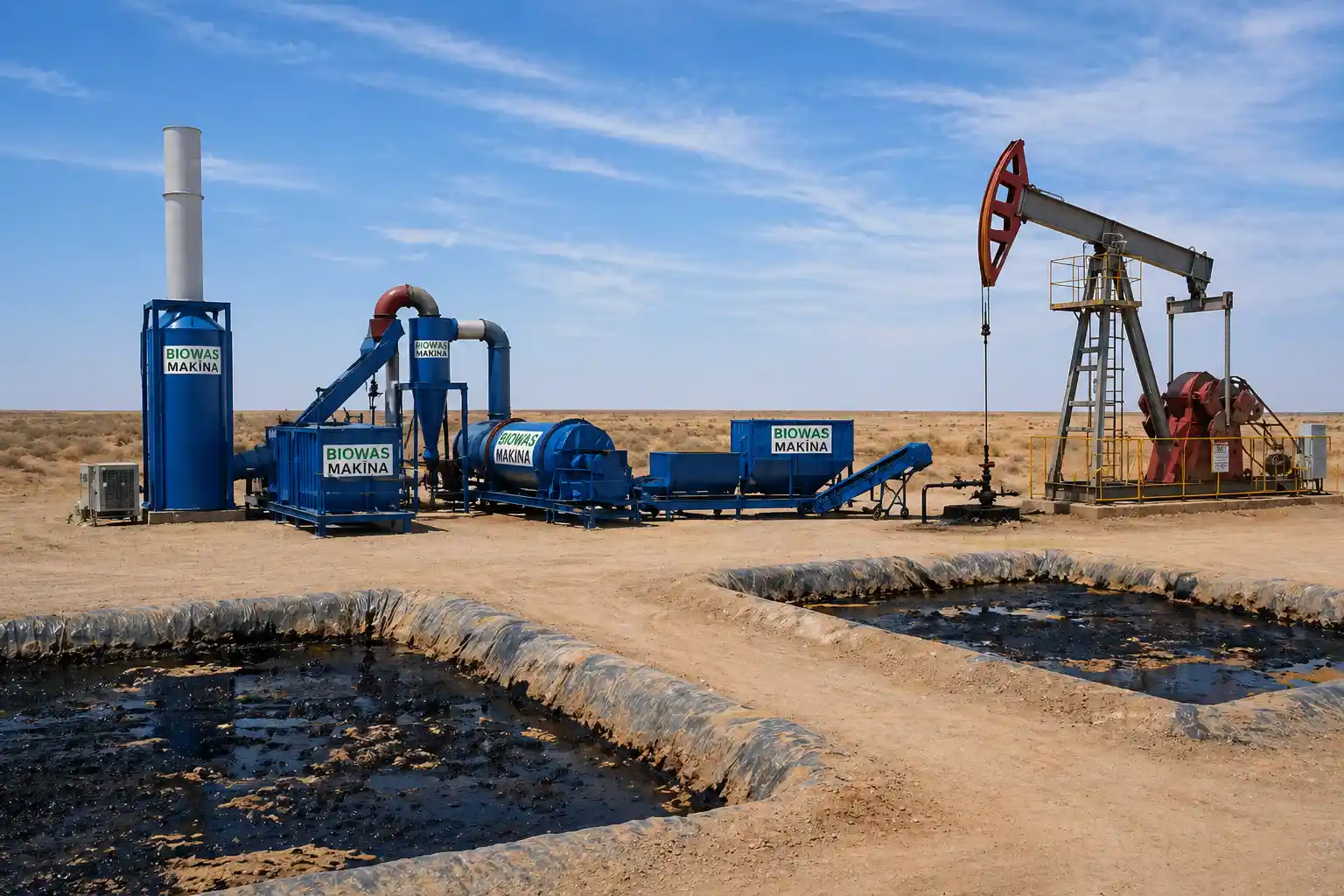
Indirect Thermal Desorption Units
Products Details
Indirect Thermal Desorption Unit are designed for the treatment of solid and semi-solid waste contaminated with hydrocarbons and volatile organic compounds. They are especially suitable for drilling sludge, mud pit residues, oily soil, refinery sludge, and other difficult materials that cannot be managed efficiently by simple storage or direct disposal. The objective of the system is to remove volatile contaminants from the solid phase and reduce the hazardous nature of the treated material under controlled thermal conditions.
The system is built around a rotary thermal treatment section in which the contaminated material is continuously fed by a hopper and conveyor into the treatment unit. In the technical process shown in the file, the material is heated and the organic contaminants are vaporized, while the remaining solids continue through the process. The technical sheet also shows that the vapors then pass through a cyclone, followed by a thermal oxidizer, a wet scrubber, a bag filter, and finally the stack for atmospheric discharge after treatment.
For your product positioning, this thermal desorption unit should be presented as an indirect thermal treatment unit, meaning that the waste is heated under controlled thermal conditions without direct flame contact with the material itself. This approach improves process control, operational safety, and suitability for hydrocarbon-bearing solids and sludge. The thermal treatment stage typically operates in the range of 400°C to 800°C, while the thermal oxidizer operates at 850°C to 1100°C to treat the generated vapors and reduce harmful emissions.
A standard installation may include the feed hopper, conveyor, rotary treatment unit, cyclone separator, thermal oxidizer, wet scrubber, bag filter, induced-draft fan, stack, water tank, cooling section, and centralized control system. With capacities from 1 T/h to 5 T/h, these units are particularly suitable for small and medium industrial projects that require controlled indirect thermal treatment and integrated emission management.
Product Drawing
| Designation | Characteristics |
| Reference | Indirect Thermal Desorption Units (TDU) |
| Application | Drilling sludge, mud pit waste, contaminated soil, oily sludge, refinery sludge, hydrocarbon-contaminated solids |
| Capacity | 1 T/h – 5 T/h |
| Working Type | Indirect thermal treatment system |
| Treatment Principle | Indirect heating, evaporation of volatile contaminants, gas treatment, and solids discharge |
| Typical Thermal Treatment Temperature | 400°C – 800°C |
| Thermal Oxidizer Temperature | 850°C – 1100°C |
| Feed Form | Contaminated solids, drilling sludge, semi-solid residues, oily soil |
| Main Process Stages | Hopper and conveyor feeding, rotary thermal treatment, cyclone separation, thermal oxidation, wet scrubbing, bag filtration, atmospheric discharge |
| Primary Feeding Section | Hopper + conveyor |
| Primary Treatment Section | Rotary calciner / rotary thermal treatment unit |
| Particle Separation | Cyclone |
| Gas Treatment Stage 1 | Thermal oxidizer |
| Gas Treatment Stage 2 | Wet scrubber |
| Gas Treatment Stage 3 | Bag filter |
| Final Discharge | Stack with ID fan |
| Operating Mode | Batch or semi-continuous depending on plant design |
| Heating Method | Indirect thermal treatment |
| Control System | Centralized PLC or industrial control cabinet |
| Installation Type | Fixed plant or modular skid-mounted system |
| Main Advantages | Controlled indirect heating, contaminant removal, integrated emission treatment, improved solids handling |
| Industrial Sectors | Oil & gas, drilling waste management, refineries, petrochemicals, contaminated-soil remediation |
How does an Indirect Thermal Desorption Unit work?
Thermal Desorption Units (TDU) work by feeding contaminated material through a hopper and conveyor into a rotary thermal treatment section. Inside this section, the material is heated under controlled conditions so that moisture and volatile organic contaminants are released from the solids. The technical process in the uploaded file shows this sequence clearly, with the heated material passing through the rotary section while the generated vapors move into the gas-treatment line.
After the thermal stage, the vapors and gases pass through a cyclone for particle separation, then into a thermal oxidizer operating at high temperature. The gas stream is then treated by a wet scrubber and a bag filter before final discharge through the stack. This multi-stage configuration allows the system to combine indirect thermal treatment of the waste with controlled treatment of the resulting emissions.
The final result is a treated solid output with reduced volatile contamination and a controlled gas-treatment sequence that supports safer and cleaner industrial operation.
Application and Case
Thermal Desorption Units (TDU) are suitable for:
- Drilling sludge treatment
- Mud pit waste treatment
- Contaminated soil remediation
- Oily sludge treatment
- Refinery sludge treatment
- Hydrocarbon-contaminated solids
- Petrochemical waste treatment
- Industrial remediation and cleanup projects
Indirect Thermal Desorption Unit are especially suitable for operators who need a reliable indirect thermal treatment solution for contaminated solids and semi-solids in the range of 1 T/h to 5 T/h. Implementing a specialized Thermal Desorption System is a strong choice for projects that require controlled heating, effective removal of volatile contaminants, and integrated treatment of process emissions in one industrial system.